
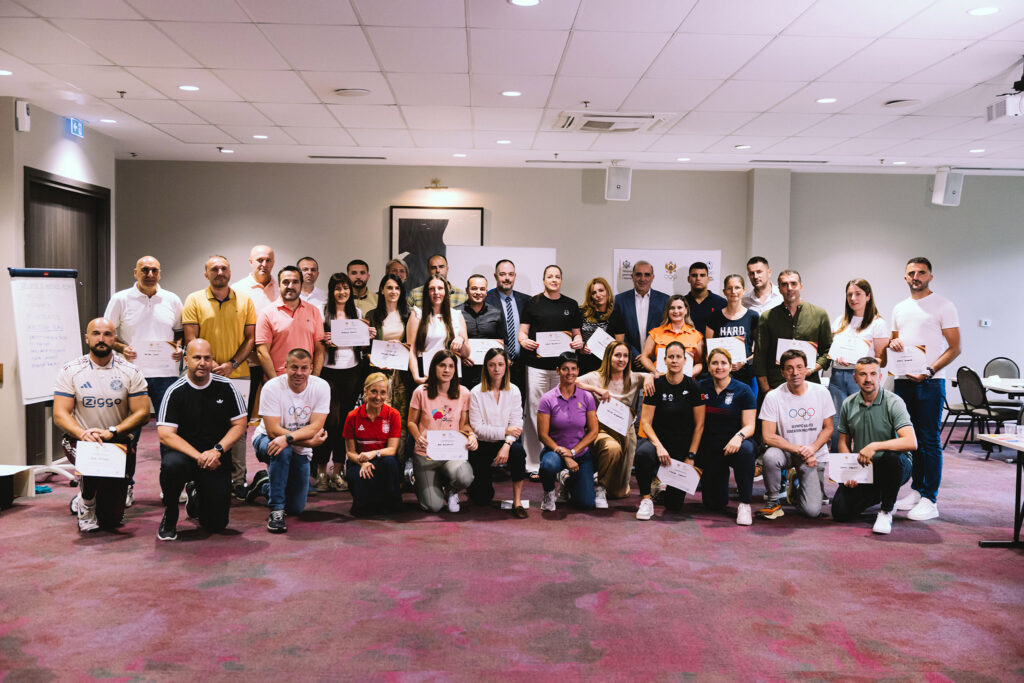
The second full-day OVEP training session for teachers from Montenegrin schools was held yesterday in Podgorica, marking the completion of preparations for the introduction of the Olympic Values Education Programme (OVEP) in 18 schools from the upcoming academic year.
This was the second and final training session in a series organised by NOC Montenegro in cooperation with the Ministry of Education, Science and Innovation. With the completion of the programme, participating teachers are now fully prepared to implement OVEP from September, at the beginning of the new school year. Throughout the training process, participants received teaching manuals that will support programme delivery in the classroom, ensuring that all conditions are now in place for the programme’s successful launch.
On the occasion of the completion of the training cycle, during the certificate award ceremony for participating teachers, the President of NOC Montenegro, Dušan Simonović, stated: “This programme is of great importance for the promotion of Olympism and Olympic values. We are implementing it in partnership with the Ministry of Education, Science and Innovation, to whom I am sincerely grateful for their trust and cooperation. I would also like to thank Olympic Solidarity of the International Olympic Committee, which provided financial support for this programme. Olympism is not only about sport; it is a set of values, and through sport these values should reach the end beneficiaries so that society as a whole can benefit. This is only the beginning, and I firmly believe we will continue this journey because the benefits will be significant for everyone involved. I am confident that we are on the right path to integrating Olympism into our education system in a meaningful way and reviving the original ideals on which it was founded.”
The Olympic Values Education Programme (OVEP) was developed by the International Olympic Committee and is being introduced in Montenegro following a positive assessment by the Bureau for Education Services and approval from the Ministry of Education, Science and Innovation.
Unlike traditional sports programmes, OVEP does not introduce a new school subject or place additional demands on the curriculum. Instead, it is naturally integrated into existing subjects and cross-curricular themes, primarily Physical Education, but also elective courses such as Sport for Athletes and Healthy Lifestyles.
The aim of the project is to advance the Olympic ideal of building a better and more humane society through sport, using an educational approach based on sports pedagogy and the Olympic values of respect, friendship and excellence. The programme content is structured around five educational themes: the joy of effort in sport and physical activity, fair play, respect for others, the balanced development of body, will and mind, and the pursuit of excellence.
Marko Vukašinović, Director General for International Cooperation at the Ministry of Education, Science and Innovation, added at the conclusion of the training: “On behalf of the Ministry of Education, Science and Innovation, I would like to express our sincere gratitude to NOC Montenegro for this initiative and for providing our teachers with the opportunity to acquire the skills necessary to bring Olympic values into our sports halls, classrooms and schools. I am convinced that, with well-prepared teachers and Montenegro’s future within the European Union, our students will have every opportunity to stand alongside their peers across Europe and beyond. Olympic values represent something fundamental – something that is particularly needed by young people today. I am confident that, in such an environment, they will grow into citizens of whom Montenegro can be proud.”
The training sessions were delivered by Nataša Janković from the Olympic Committee of Serbia, Goran Prebeg from the Faculty of Sport and Physical Education at the University of Belgrade, Bojan Gerzina from the Filip Filipović Primary School in Belgrade, and Svetlana Nikolić, HR consultant and member of the SPIN team. With more than a decade of experience in implementing similar educational programmes, the trainers provided participants with proven methodologies and practical examples of OVEP implementation in school settings.
Reflecting on the importance of the programme and the cooperation between the two National Olympic Committees, Nataša Janković of the Olympic Committee of Serbia stated: “Cooperation between Olympic Committees is extremely valuable, primarily because it allows for the exchange of experiences, good practices and different working methods. What we often discover is that we share many of the same challenges, even when it may not seem so at first. When everyone is open and willing to share both difficulties and successful examples, trust grows and learning becomes much easier. This seminar was an excellent opportunity for exactly that. I believe we all learned a great deal and found inspiration that will influence our future work, both as educators and as programme participants.”
The importance of introducing OVEP into Montenegro’s education system lies in its direct response to challenges currently faced by schools, including declining levels of physical activity among children, peer violence, intolerance and the need for the systematic development of students’ social and emotional skills.
The programme promotes the holistic development of young people through the three core Olympic values of excellence, friendship and respect, using sport and movement as educational tools rather than competitive disciplines.
NOC Montenegro extends its gratitude to the schools, teachers and students whose commitment and participation contributed to the success of the project, as well as to the Ministry of Education, Science and Innovation and the Bureau for Education Services for their cooperation. By introducing OVEP into Montenegrin schools, the programme reinforces the idea of sport as a school of life, a principle on which Pierre de Coubertin based the revival of the modern Olympic Games.
The programme will be implemented from September in the following schools: Novka Ubović, Savo Pejanović, Sutjeska, Milorad Musa Burzan, Maksim Gorki and Radojica Perović Primary Schools in Podgorica; Vuk Karadžić, Marko Miljanov and 21. maj Primary Schools in Bijelo Polje; Olga Golović and Branko Višnjić Primary Schools, and Stojan Cerović Gymnasium in Nikšić; Jugoslavija and Kekec Primary Schools in Bar; Blažo Mraković Primary School in Danilovgrad; Tucanje Primary School in Petnjica; Mirko Srzentić Primary School in Petrovac; and Njegoš Primary School in Kotor.
PHOTO Gallery – https://flic.kr/s/aHBqjCWM84