
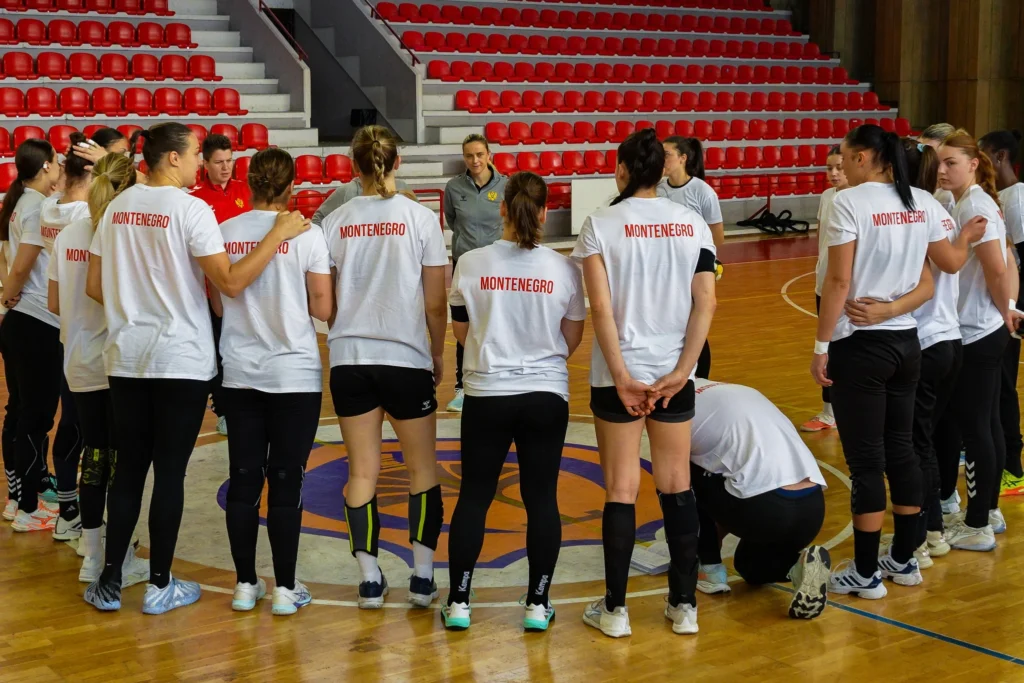
Montenegro’s women’s national handball team held a training camp during the EHF national team week, from 19 to 24 October, as part of the Recovery and Regeneration Programme implemented by the Montenegrin Olympic Committee (NOC Montenegro) and SIRO Porto Montenegro for athletes on the road to the Los Angeles 2028 Olympic Games. A total of 20 players, accompanied by their coaching staff, stayed at SIRO Porto Montenegro in Tivat. Handball is the first team sport to participate in the programme.
The national team was preparing for the European Championship, which will take place from 3 to 20 December in Poland, Romania, Czechia, Slovakia and Türkiye. Montenegro will compete in Group A in Oradea, Romania, opening their campaign against Hungary on 3 December before facing Iceland and Slovenia.
This phase of the programme focused on the specific needs of athletes competing in a team sport, where a demanding match schedule and intense competitive rhythm require effective recovery between training sessions and matches, as well as the physical and mental readiness to repeatedly meet the demands of major competitions.
Throughout the training camp, the players had access to accommodation in restorative rooms, fitness facilities, a swimming pool, recovery treatments and nutritional support. Working alongside the coaching staff, the programme focused on regeneration between training sessions and managing the different physical workloads of players joining the national team from various clubs and leagues.
Nikolina Marković highlighted the particular demands of post-match recovery, given both the physical and psychological strain involved:
“Recovery after a match is much more intensive than after training. There is greater physical exertion, but also psychological strain, so with the help of physiotherapists and the available therapies and treatments, we try to relax our muscles, restore lost energy and prepare our bodies for what lies ahead. After training, recovery is much quicker and easier, but it is an everyday part of our routine,” Marković said.
Major tournaments, where matches are played almost every day, present an additional challenge.
“Everything happens very quickly, practically from one day to the next. You have to find a way to cope with significant stress, expectations and fatigue. That is perhaps the greatest challenge of competing at major tournaments, where you constantly have to find a new source of energy and the ability to give your very best once again,” Marković explained.
She also emphasised how important it is for athletes to have a support system that takes care of their needs beyond the court.
“An athlete cannot do everything alone. When there is a well-organised system behind you, with people who think about every detail of an athlete’s life off the court, it creates a sense of security and allows us to focus on our job. And our job as athletes is to deliver results on the court,” Marković said.
Jelena Vukčević placed particular emphasis on the mental aspects of recovery and the challenges posed by fatigue during major competitions.
“As the tournament progresses, things become increasingly difficult and fatigue sets in. At that point, physical fitness is no longer the only thing that matters. It is extremely important to stay focused and find the mental strength to respond to every challenge. The motivation is always there, but you have to find the strength to keep going even when you are tired,” Vukčević said.
In those moments, she added, the strength of the team becomes especially important.
“The team is what matters most. We are like one family, not individuals, and it is precisely in those moments that you see how connected we are and how strong we are together. We know each other well enough to recognise when one of us is struggling or showing signs of fatigue, and that is when we need each other the most,” Vukčević explained.
For Vukčević, competing at the Olympic Games remains one of her greatest sporting ambitions.
“I would love to experience that pride and happiness one day, but also the responsibility that comes with the Olympic Games. It would be the pinnacle of my career and the fulfilment of my greatest wish. Wearing the national team jersey is something special, and it is not a cliché when athletes talk about that feeling. You represent not only yourself, but also your family, your country and your team. It is a great responsibility, but also a great honour,” Vukčević said.
Dijana Mugoša already has experience of competing on sport’s biggest stage and hopes to see a new generation of Montenegro’s Lionesses return to the Olympic Games.
“I am always here because I want to give everything I have to help us qualify once again and give the younger players the opportunity to experience what I have experienced. It is the most wonderful feeling possible and, for me, the greatest honour an athlete can achieve. It is something we strive towards throughout our careers. Wearing your country’s jersey at the Olympic Games is something truly special, both an honour and a responsibility,” Mugoša said.
Speaking about younger players, Mugoša stressed the importance of trust and encouragement.
“Every generation brings something new. I want people to believe in the younger generation and give them their full support, with less criticism and more praise. I believe that this is how we can bring out the best in every young player and give them the opportunity to reach their full potential,” Mugoša explained.
National team head coach Suzana Lazović emphasised that effective recovery is particularly important when preparing for major competitions, as the coaching staff must manage the different workloads of players arriving from their respective clubs.
“The biggest challenge comes from the leagues in which the players compete and the fact that we have only seven to ten days before the championship. It is our responsibility to do our part, bring the players together, manage their workloads and assess which players are in the best form and capable of handling the demands of the championship,” Lazović said.
She also highlighted the importance of support from the Montenegrin Olympic Committee and programmes that provide athletes with additional resources for preparation and recovery.
“As someone who has competed at the Olympic Games, I want these players to experience what it means to be part of the Olympic world and the conditions that the Olympic Committee can provide. This is a valuable stepping stone and an opportunity to build positive team spirit, so that already at the European Championship we can demonstrate how all of this has contributed to our collective development and preparations for the 2028 Olympic Games,” Lazović said.
Lazović identified the health of the team, quality preparations and a return to the Olympic stage as the main priorities.
“Above all, I want everyone to stay healthy and for us to qualify for the Olympic Games. If we truly want something, we can achieve it. The Lionesses showed and proved what we are capable of in 2012. I believe that Montenegrin handball players, as well as all Montenegrin athletes, can achieve further Olympic appearances and medals in the years ahead, drawing on what we have in Montenegro and, above all, our character and mentality,” Lazović concluded.
The handball team’s training camp forms part of the Recovery and Regeneration Programme, launched this year by NOC Montenegro and SIRO Porto Montenegro to provide Montenegrin athletes on the Olympic pathway with a structured approach to recovery, regeneration, sleep, nutrition and mental health.
The programme is designed for NOC Montenegro scholarship holders competing in individual sports, as well as athletes from team sports who are potential participants in the Los Angeles 2028 Olympic Games.
Before the handball team, taekwondo athletes and swimmers had already taken part in the programme, which will continue with judokas in December.